
If you run a roofing, water damage restoration, HVAC, or plumbing business, your marketing landscape in 2026 looks very different from what it did just two years ago. Google has shifted. Consumer behaviour has shifted. And the contractors who are winning right now are the ones who figured out the right order to build their stack.
This isn’t a post about chasing every new marketing trend. It’s about understanding the structure that actually drives consistent, qualified leads for home service businesses in competitive markets right now, and building it in the right order.
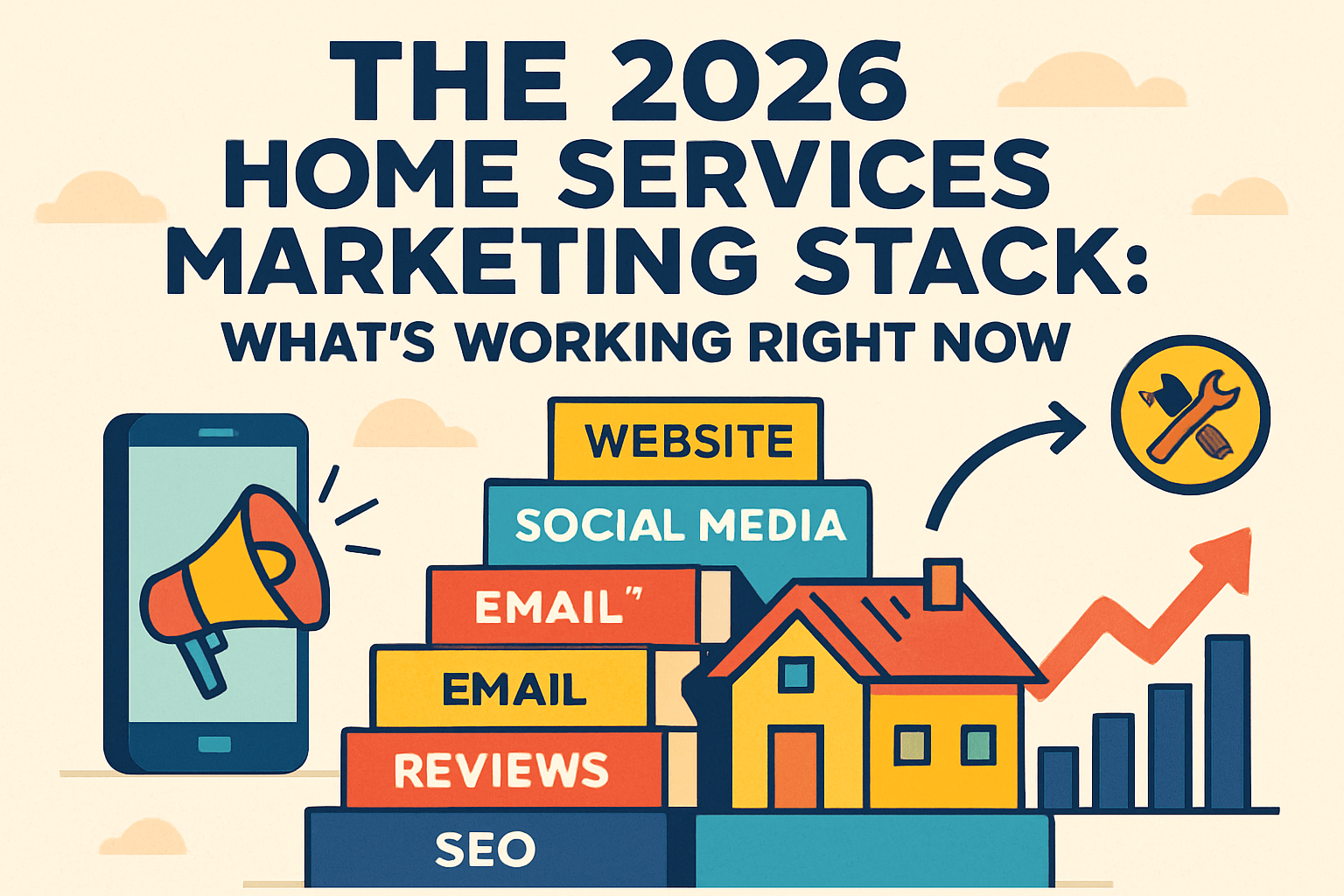
Here’s the complete 2026 home services marketing stack, broken down layer by layer.
Layer 1: Local SEO and Google Business Profile
Everything starts here. Before you spend a single dollar on paid advertising, your Google Business Profile needs to be built, verified, and actively maintained.
Most home service contractors underestimate how central the GBP is to their entire marketing operation. It’s not just about ranking in the map pack anymore. Your GBP directly affects your Local Services Ads performance, your organic visibility, and how Google perceives the legitimacy and trustworthiness of your business.
What a properly optimized GBP looks like in 2026
- Business categories that match your core services exactly
- Service areas set to reflect where you actually operate
- Business hours accurate and updated consistently
- Regular photo uploads showing real jobs and your team
- A steady stream of fresh Google reviews
- Responses to every review, positive and negative
- Google Posts updated regularly with offers or news
Think of your GBP as your LSA credit score. Google checks it before deciding how often to show your Local Services Ads. The stronger your profile, the more visibility you get, and the lower your effective cost per lead becomes across every paid channel.
Local SEO goes beyond your GBP. It also includes your website’s on-page optimization, local citations across directories like Yelp, Angi, and HomeAdvisor, and the overall authority your domain builds over time. This is the work that generates near-zero cost per click organic leads once it compounds.
For roofing contractors, HVAC companies, water damage restoration businesses, and plumbers, local SEO is a long-term asset. The businesses that started building it 12 to 18 months ago are now seeing organic traffic that costs them almost nothing per lead. The ones waiting to start are falling further behind every month.
Why Local SEO comes first
Paid channels amplify what already exists. If your local SEO foundation is weak, your paid ads are working twice as hard for half the result. Google’s algorithm rewards businesses with strong organic signals. That means better LSA placement, lower CPCs in Google Ads, and more qualified traffic across every channel.
Build the foundation. Then layer on the paid channels above it.
Layer 2: Local Services Ads (LSA)
If you’re a home service contractor in 2026 and you’re not running Local Services Ads as your primary paid channel, you’re paying more per lead than you need to.
LSA has moved from a secondary option to the main driver for most home service categories. Google is actively pushing businesses here, and the placement reflects it. LSA sits above traditional paid search ads, above the map pack, and at the very top of the search results page.
Why LSA outperforms traditional paid search for home services
- Pay per lead, not per click. You’re not funding Google’s guessing game.
- LSA listings don’t look like traditional ads. Homeowners see your profile, star rating, and phone number. It looks organic. That’s why it converts.
- The Google Guaranteed badge tells homeowners your business has been vetted before they even pick up the phone. You can’t replicate that trust signal in a standard search ad.
- Google’s verification process filters out low-quality operators. Homeowners have started to recognize that.
LSA leads also skip your website entirely. The call comes directly from the ad. That means your landing page isn’t a variable in the conversion process. You just need to answer the phone and close the job.
What you need to run LSA properly
LSA rewards businesses that are fully built out. Here’s what needs to be in place before you expect results:
- GBP with correct categories and service areas
- A minimum of 15 to 20 reviews, with recent activity
- License and insurance verified in the LSA dashboard
- Budget set competitively enough to show consistently
- Direct business search turned off (more on this below)
One setting that quietly drains LSA budgets for contractors across every trade: direct business search. When this is turned on, Google charges you every time someone searches your business name directly. These are people who already know you. They were going to call you anyway. Turn it off and redirect that spend toward discovery, homeowners who don’t know you yet but need exactly what you do.
LSA by trade: what to expect
LSA availability and performance varies by category. Here’s how it generally breaks down for the most competitive home service trades:
- Roofing: LSA eligible in most markets. Strong conversion rates where GBP is solid. Cost per lead typically lower than paid search in comparable markets.
- Water damage restoration: One of the highest-performing LSA categories. Emergency intent is high. Homeowners want the fastest, most trusted response. LSA wins here.
- HVAC: LSA works exceptionally well for HVAC. Seasonal demand spikes make the pay-per-lead model particularly valuable.
- Plumbing: High emergency intent. LSA converts well. The Google Guaranteed badge carries significant weight for a trade where homeowners are particularly concerned about trust.
Layer 3: Google Ads (Paid Search)
Traditional Google Ads still has a role in the 2026 home services stack, but it’s the support act, not the headline.
LSA covers a lot of ground. But there are gaps. High-intent commercial keywords that LSA won’t show for. Brand protection. Competitor campaigns. Specific service areas or job types you want to target with precision. This is where paid search picks up.
Here’s the important part: paid search traffic does land on your website. Which means your site needs to be ready. A slow, generic homepage will kill leads that your ads already paid for. Fast load times, clear calls to action, real reviews and trust signals on the page, and a specific offer or reason to call. That’s what a conversion-ready landing page looks like in 2026.
The Google Ads play that’s working right now
Most home service contractors run Google Ads like it’s one campaign with one strategy. It’s not. The approach we’re seeing work consistently right now is a two-phase sequence.
Phase 1: Exact match only.
Start with exact match keywords using high-intent modifiers. The kinds of searches that signal a buyer, not a researcher.
- “Water damage restoration contractor [city]”
- “Roofing company near me”
- “Emergency plumber [city]”
- “HVAC contractor [city]”
Not broad terms. Not research queries like “how much does a new roof cost.” People actively looking to hire someone right now.
Run this phase for four to six weeks. Let clean conversion data stack. Learn which keywords are actually driving calls and booked jobs. This is the foundation everything else is built on.
Phase 2: Introduce a second campaign on AI Max at half the budget.
Once your exact match campaign has real conversion data behind it, launch a separate campaign on AI Max at half the budget of your primary campaign.
Now the machine has something to learn from. Real buyers. Real conversion signals. Real intent data. AI Max uses that to find adjacent searches your exact match campaign wouldn’t reach, queries you’d never think to target, and converts them using the patterns it’s already identified from your best-performing traffic.
This is how you scale beyond the volume ceiling that exact match keywords hit on their own. Without the Phase 1 foundation, AI Max is just guessing. With it, it’s compounding.
What Google Ads actually costs in competitive home service markets
One of the most common mistakes contractors make is going into Google Ads with an unrealistic budget. Here’s what the real numbers look like:
- Roofing and water damage: CPCs of $50 or more in most markets. Some keywords push $100 to $150 per click in major metros. At a 10 to 20% landing page conversion rate, cost per lead lands at $300 to $500. At a 30% close rate, cost per acquired customer is $1,000 to $1,500.
- HVAC and plumbing: CPCs typically in the $20 to $40 range. Slightly better conversion rates due to emergency intent. Cost per lead in the $100 to $200 range in most markets.
These numbers might feel high. But for trades where average job value sits at $5,000 to $15,000 or more, the ROI is there when the sales process is tight.
The problem isn’t the spend. It’s contractors going in at $500 a month, getting $1 clicks from the Display Network, and wondering why the leads are spam and job seekers. Cheap clicks in high-value trades are a red flag. If you’re not bidding at the top of the CPC range, you’re not showing up where the buyers are.
Layer 4: Call Tracking and Pipeline Visibility
You can build the perfect 2026 marketing stack and still have no idea what’s working.
Because without call tracking, every channel looks the same in your reporting. LSA, Google Ads, organic, referral, they all show up as leads with no source attached.
Call tracking gives you:
- Which campaign drove each call
- Which keyword triggered the ad
- Whether the call was answered and handled properly
- Whether it converted to a booked job
- Cost per acquired customer by channel
Without this data, you’re making budget decisions on gut feeling. With it, you cut what isn’t working and put more behind what is.
For roofing, water damage, HVAC, and plumbing businesses where job values are high, even a single misattributed lead can distort your entire picture of which channels are profitable. Get tracking set up across every touchpoint before you scale anything.
How the Stack Works Together
The reason this stack works is because each layer feeds the one above it.
Strong local SEO and GBP makes your LSA more competitive. LSA generates high-trust leads at a lower CPL than paid search. Google Ads fills the gaps LSA can’t cover and protects your brand. AI Max compounds on the conversion data your exact match campaigns built. Call tracking tells you what’s actually working so you can make real decisions.
Single-channel marketing is the most expensive mistake a home service business can make right now. CPCs in roofing and water damage are $50 or more per click. When paid search is your only play, one bad month can kill your pipeline. When you stack all four layers, each channel offsets the weakness of the others.
The contractors winning in 2026 aren’t just spending more. They’re building smarter.
Build It in the Right Order
Most home service businesses build their marketing backwards. They jump straight to Google Ads before their GBP is complete. They run LSA without enough reviews to be competitive. They turn on AI Max before they have any conversion data to learn from.
Then they wonder why the results aren’t there.
Here’s the order that works:
- Step 1: Build and optimize your Google Business Profile. Get reviews coming in consistently. Nail your categories and service areas.
- Step 2: Get your website conversion-ready. Fast, clear, full of trust signals. This is where your paid search traffic lands.
- Step 3: Launch LSA. Get verified, earn the Google Guaranteed badge, and start generating leads at a lower CPL than traditional search.
- Step 4: Layer in Google Ads with exact match, high-intent keywords. Stack four to six weeks of clean conversion data.
- Step 5: Introduce AI Max as a second campaign at half the budget. Let the machine scale on real signals.
- Step 6: Set up call tracking across every channel. Know your cost per acquired customer by source.
Skip a layer and the whole stack underperforms. Do it in order and you build something that compounds over time.
Ready to Build Your 2026 Stack?
If you’re a roofing, water damage, HVAC, or plumbing business owner trying to figure out where to focus your marketing this year, the stack above is where we’d start every single time.
At Thomas Town Digital, we work exclusively with home service businesses. We know what the real numbers look like in your trades, and we know how to build marketing systems that drive qualified leads at a cost that makes sense for your business.
If you want to talk through where your current setup sits and what the right next step looks like, get in touch through the contact form below. No hard sell. Just a straight conversation about what’s working and what isn’t.

[…] is not a standalone solution. It works best as part of a structured marketing stack, with Local SEO as the foundation and traditional Google Ads filling the gaps above […]