

LSA has moved from a secondary option to the primary paid channel for most home service businesses. Here’s a complete breakdown of how it works, what’s changed, and exactly how to set it up to generate qualified leads consistently.
If you run a roofing company, water damage restoration business, HVAC contractor, or plumbing operation and you’re still treating Local Services Ads as an optional extra, this post is going to change how you think about your marketing.
LSA is no longer a supplementary channel. For the majority of home service trades, it is the most efficient paid lead generation tool available right now. Google has been pushing hard in this direction, and the placement reflects it. LSA sits above traditional paid search ads, above the map pack, at the very top of the page.
But it only works when it’s set up properly. And most contractors are running it wrong.
What Local Services Ads Actually Are
Local Services Ads are a Google ad format specifically designed for service-based businesses. Unlike traditional Google Ads where you pay per click, LSA operates on a pay-per-lead model. You only pay when a potential customer contacts you directly through the ad.
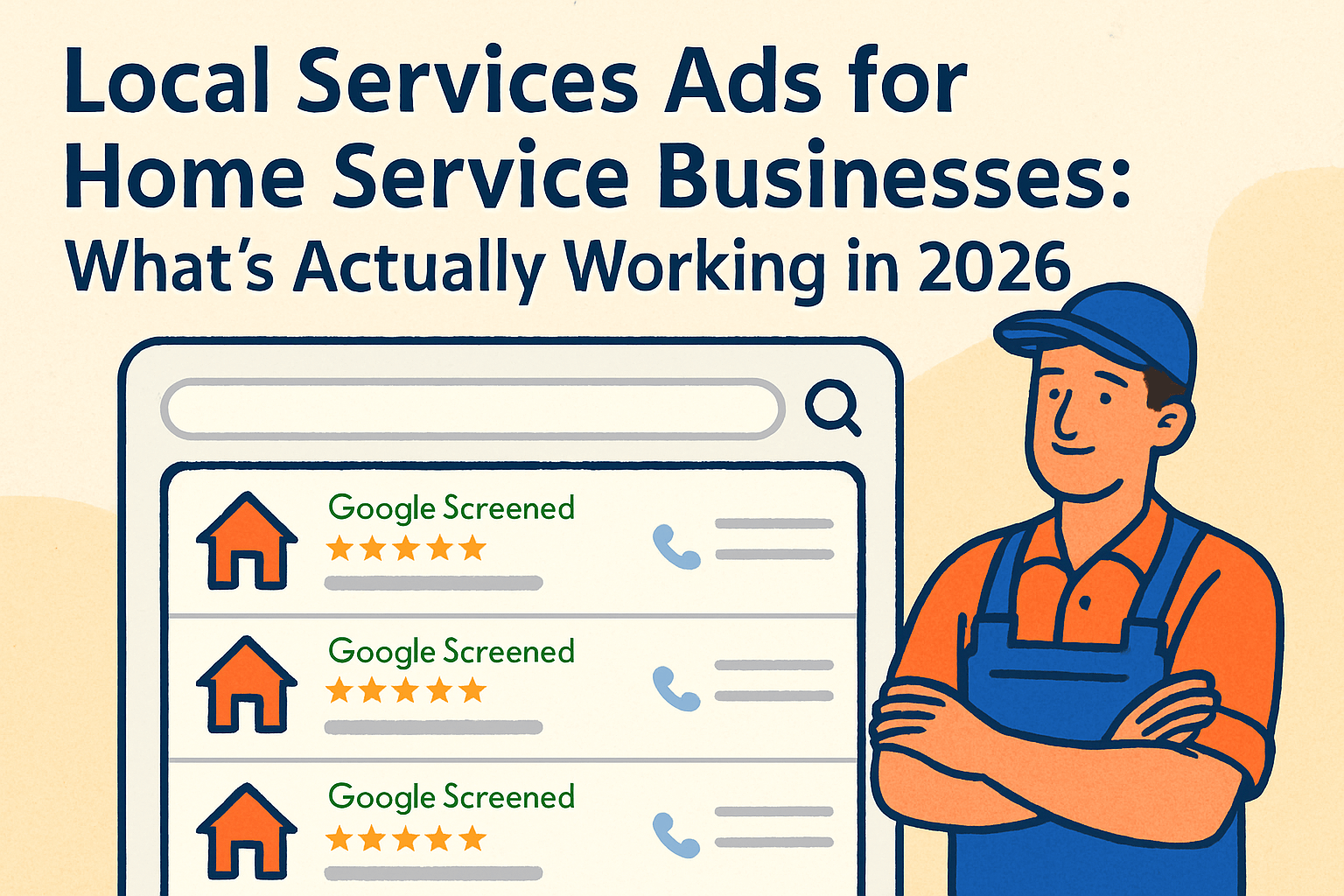
The format looks completely different from a standard search ad. Instead of a headline and description in a text block, homeowners see your business name, star rating, number of reviews, years in business, and a direct phone number or message option. There’s no website click involved. The lead comes straight to you.
That’s a significant distinction. LSA leads bypass your website entirely. A homeowner searching for an emergency plumber at 11pm isn’t interested in reading your service pages. They want to call someone now. LSA puts your phone number directly in front of that intent.
The Google Guaranteed badge
One of the most underappreciated elements of LSA is the verification process behind it. To run LSA, Google verifies your business license, insurance, and in many cases runs background checks. Businesses that pass this process earn the Google Guaranteed badge.
That badge tells homeowners, before they even make contact, that Google has vetted your business. In a trade like plumbing or water damage restoration, where someone is inviting a contractor into their home during a stressful situation, that trust signal matters more than almost anything else in your ad.
You cannot replicate the Google Guaranteed badge in a traditional paid search ad. It’s unique to LSA, and it’s one of the core reasons LSA converts better than traditional search for most home service categories.
Why LSA Is Beating Traditional Paid Search Right Now
The shift toward LSA isn’t just about Google pushing a new format. There are structural reasons why it outperforms traditional paid search for home service businesses in 2026.
Pay per lead, not per click
In a traditional Google Ads campaign for roofing or water damage restoration, you can pay $50 to $150 per click. Some of those clicks are serious buyers. Many aren’t. You’re funding every search, every curious homeowner, every researcher who has no intention of hiring anyone today.
LSA flips this model. You pay when someone actually contacts you. Google carries the risk of the clicks that don’t convert. For contractors in high-CPC trades, this is a meaningful financial advantage.
The format builds trust before the call
Traditional paid search ads look like ads. Increasingly, homeowners scroll past them or treat them with skepticism. LSA listings look different. The profile format, review stars, and Google Guaranteed badge position your business more like an organic recommendation than a paid placement.
That perception difference translates directly into conversion rates. Homeowners are more likely to call a business that looks vetted and trusted than one running a standard text ad.
Premium placement that money alone can’t buy
In traditional Google Ads, placement is largely determined by bid and Quality Score. In LSA, Google’s ranking algorithm weights your GBP strength, review velocity, responsiveness, and proximity to the searcher alongside your bid.
This means a well-optimized business with strong reviews can outrank a competitor with a higher budget. The playing field rewards preparation, not just spend.
The Foundation LSA Requires: Your Google Business Profile
Here’s what most contractors miss when LSA doesn’t perform: the problem almost never starts inside the LSA dashboard. It starts with the Google Business Profile underneath it.
Think of your GBP as your LSA credit score. Google checks it before deciding how often to show your ads, in what positions, and at what cost. A strong, active, fully-built GBP means more impressions, better placement, and a lower effective cost per lead. A neglected GBP means your LSA barely runs.
What a GBP needs to support strong LSA performance
- Business categories that precisely match your core services. Google uses these to match your ads to the right searches.
- Service areas that reflect where you actually work. Overly broad service areas can hurt your relevance score.
- Accurate business hours, including emergency availability if applicable.
- Regular photo uploads showing real jobs, your team, and your vehicles.
- A consistent flow of fresh Google reviews. Review velocity matters as much as review count.
- Responses to all reviews. Google tracks engagement as a signal of business activity.
- An active posting schedule. Google Posts signal to the algorithm that your business is maintained.
The businesses that consistently show at the top of LSA in competitive markets like roofing, water damage, and HVAC are not just outbidding everyone else. They’ve built GBP profiles that Google trusts enough to recommend to its users.
Setting Up LSA: The Full Checklist
Running LSA and not getting leads is almost always a setup problem. Here’s the complete checklist for every contractor before expecting consistent results.
Before you launch
- Google Business Profile fully optimized with correct categories, service areas, and hours
- Minimum of 15 to 20 Google reviews, with recent activity in the last 60 days
- Business license submitted and verified in the LSA dashboard
- Proof of insurance uploaded and current
- Background check completed if required for your category
- Business hours set accurately in the LSA platform
- Services configured to match what you actually want to be called for
Budget and bidding
One of the most common reasons contractors don’t see results from LSA is underbidding. If your weekly budget isn’t competitive enough to show consistently, Google will simply show other businesses first.
There’s no universal budget recommendation because it depends heavily on your market size, the number of competitors running LSA in your area, and your target lead volume. What we can tell you is that if you set a budget that feels comfortable and you’re getting almost no leads, the budget is almost certainly part of the problem.
Start with a budget that allows for at least five to ten leads per week in your market. Adjust based on lead quality and job conversion after the first four weeks.
The direct business search setting
This one setting quietly burns budget for contractors across every trade.
When direct business search is turned on in your LSA settings, Google charges you when someone searches your business name directly. These are people who already know you and were going to call you regardless. You should not be paying a premium to capture leads from your own existing reputation.
Turn this setting off. Every dollar saved there goes toward discovery leads, homeowners who don’t know you yet but need exactly what you do. That’s where LSA delivers its real value.
LSA by Trade: What to Expect
LSA performance varies by category. Here’s how it typically plays out for the four trades we work with most.
Roofing
LSA is available in most markets for roofing contractors and performs well when the GBP is strong and reviews are consistent. The cost per lead via LSA is typically lower than what you’d pay for the equivalent traffic through traditional paid search, where CPCs regularly exceed $50 per click.
The key for roofing is review volume and recency. In a competitive roofing market, the top LSA positions are often held by contractors with 50 or more reviews and consistent new review activity. If your review profile is stale, that’s the first thing to fix.
Water damage restoration
This is one of the highest-performing LSA categories we see. Emergency intent is extremely high. A homeowner searching for water damage restoration at 2am is not comparison shopping. They need someone now.
The Google Guaranteed badge carries exceptional weight in this category. The job is entering someone’s damaged home during a crisis situation. Trust is the primary buying factor, and LSA delivers that trust signal before the homeowner even makes contact.
For water damage businesses, the combination of high emergency intent, high average job value (often $5,000 to $15,000+), and LSA’s pay-per-lead model creates some of the strongest ROI we see across any paid channel.
HVAC
HVAC is one of the most LSA-friendly categories available. Seasonal demand spikes, emergency service calls, and high average job values make the pay-per-lead model particularly valuable.
The challenge for HVAC contractors is managing lead volume during peak seasons. When your LSA is optimized and demand spikes, you need to make sure your team can respond to leads fast. LSA’s ranking algorithm factors in response time. If you’re slow to answer during a demand surge, your placement will reflect it.
Plumbing
High emergency intent, consistent year-round demand, and homeowners who are particularly concerned about trust and verification make plumbing one of the strongest LSA categories.
For plumbing contractors, the Google Guaranteed badge is arguably even more impactful than in other trades. Someone dealing with a burst pipe or sewage backup is in a high-stress situation and making a fast decision. The badge provides the trust shortcut that closes the gap between seeing your ad and picking up the phone.
How LSA Fits Into Your Wider Marketing Stack
LSA is not a standalone solution. It works best as part of a structured marketing stack, with Local SEO as the foundation and traditional Google Ads filling the gaps above it.
Here’s how the three layers interact:
- Local SEO and GBP: This is what makes LSA competitive. A strong GBP is the input. Better LSA placement and lower effective CPL is the output.
- LSA: Your primary paid lead generation channel. Lower CPL than traditional search. Pay per lead. Direct phone calls. No website needed.
- Google Ads: Fills the gaps. High-intent keywords LSA won’t show for. Brand protection. Competitor campaigns. This is where your website conversion matters.
The contractors with the best marketing ROI right now are running all three in coordination. Not as separate strategies, but as a system where each layer feeds the next.
If you’re only running one of these channels, you have a single point of failure. A bad month in Google Ads, or a period where LSA leads slow down, can kill your pipeline. With all three running properly, the dip in one is covered by the strength of the others.
Common LSA Mistakes Contractors Make
Before we wrap up, here are the most common reasons LSA underdelivers for home service businesses and how to fix them.
1. Launching LSA on a weak GBP.
If your GBP is incomplete, has outdated categories, or has very few recent reviews, fix that first. LSA performance is directly tied to GBP quality. Don’t run ads on a broken foundation.
2. Setting the budget too low.
An underfunded LSA campaign won’t show consistently. If you’re getting almost no leads, increase the budget before changing anything else. Many contractors abandon LSA because of a budget problem they’ve diagnosed as a platform problem.
3. Leaving direct business search turned on.
Covered above, but worth repeating. Turn this off. Stop paying for people who were already going to call you.
4. Not responding to leads fast enough.
Google’s LSA algorithm rewards responsiveness. If leads are going unanswered or callbacks are slow, your placement will drop. Answer the phone. Call back missed leads within minutes, not hours.
5. Disputing every lead.
The LSA platform allows you to dispute leads that don’t meet your criteria. This is a legitimate feature. But disputing too aggressively can flag your account and affect performance. Dispute leads that are clearly invalid. Accept the ones that are borderline.
6. Not tracking what happens after the lead.
LSA tells you how many leads you received. It does not tell you how many became booked jobs. Without call tracking and CRM integration, you have no visibility into your actual cost per acquired customer. Set this up before you scale anything.
Want to Get LSA Working for Your Business?
LSA done right is one of the best paid lead generation investments available to home service contractors right now. But the setup matters, and the foundation underneath it matters even more.
At Thomas Town Digital, we work exclusively with home service businesses across roofing, water damage, HVAC, and plumbing. We know what the real numbers look like in your trades, and we know how to build the full stack that makes LSA perform the way it should.
If you want to talk through your current setup, whether you’re just getting started with LSA or troubleshooting why it isn’t delivering, reach out through the contact form below. We’ll give you a straight assessment of where you are and what the right next step looks like.
